
Language has been a barrier for too long—especially in software, where “global” often still means “English-first.”
Today we’re changing that: ShareAI is now available in 30 of the world’s most-used languages.
This isn’t a vanity translation pass. It’s a mission move: ShareAI exists to democratize access to compute—regardless of where compute is offered, or where it’s requested. If language blocks people from discovering, understanding, or using the product, then access isn’t truly open.
Language has been a barrier for too long
Most people don’t avoid building because they lack ideas—they avoid building because the first step is friction.
And language friction is brutal:
- You miss critical nuance in docs.
- You hesitate to click “Create API key” if you’re not 100% sure what it does.
- You don’t report issues because writing in English feels like extra work.
If we want AI to be for everyone, we have to ship experiences that work outside the default bubble.
What’s new: ShareAI is now available in 30 languages
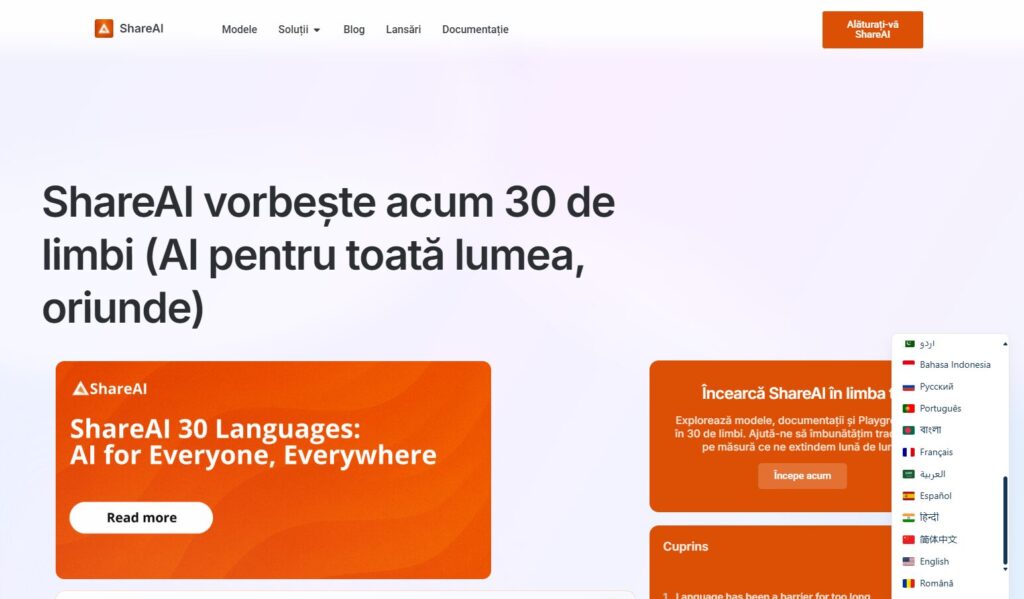
Starting now, you can use ShareAI in your preferred language across the core experience—so you can get value without translating everything in your head first.
If you’re new to ShareAI, a good starting path is:
- Explore the Models marketplace
- Read the Documentation
- Try the Playground
And if you’re ready to build:
Rollout plan: starting with the blog, expanding month by month
This is important: we’re starting with blog content first, then expanding.
Why? Because blog posts are often the first touchpoint. They explain why something exists, how to use it, and what to do next. If that layer isn’t accessible, the rest doesn’t matter.
Phase 1 (now): blog + key pages
Blog posts and core pages will be translated first so anyone can discover ShareAI and understand the basics.
Phase 2 (next months): deeper product coverage
Over the coming months, we’ll extend translation coverage across more of the product experience—iterating based on usage and feedback.
How we’ll prioritize
We’ll prioritize what people actually use:
- Highest-traffic pages
- Onboarding and key flows (sign-in, API key creation, first run)
- Docs sections that unblock real integrations
How we translate (and how you can help)
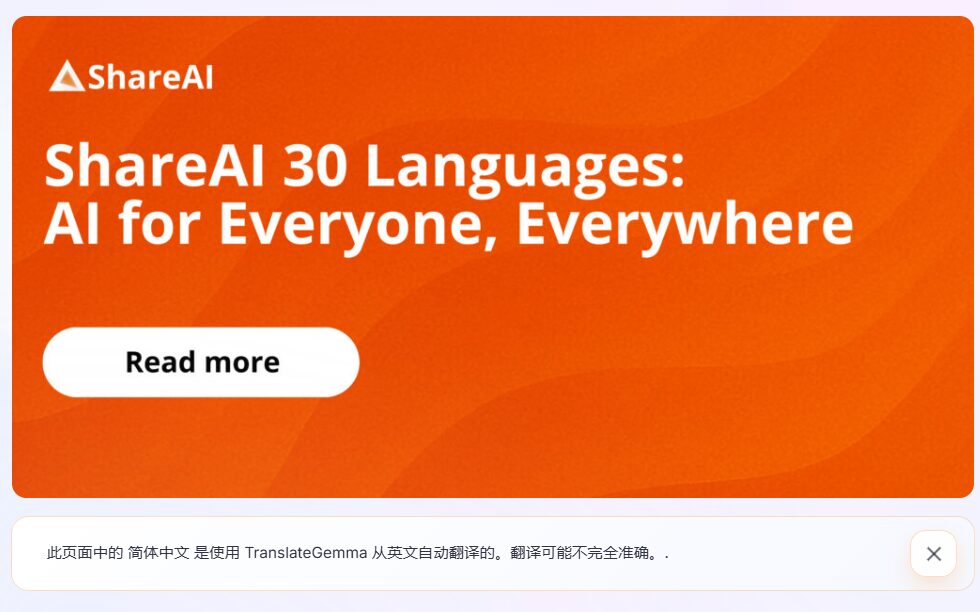
We’re using TranslateGemma (Gemma) to power these translations. TranslateGemma is a family of open translation models built on the Gemma model line (read the TranslateGemma announcement).
And we’ll be direct: it won’t be perfect, so we are letting you know about this in every place where we use AI to translate content, as we improve this in the months that follow.
Translation quality isn’t just grammar. It’s:
- Meaning
- Technical terminology
- UI consistency
- Whether it reads like a native product (not a “translated one”)
If you spot something incorrect, please tell us
If you see anything that’s awkward, misleading, or technically wrong, send us a message with:
- The page URL
- The sentence/section that’s wrong
- What it should say (even approximate is helpful)
We’ll use that feedback to improve the experience language-by-language.
Why multilingual ShareAI supports the mission
ShareAI is built to make AI infrastructure more accessible:
- For teams building products
- For businesses trying to automate
- For builders anywhere—regardless of region
When language becomes optional, access becomes real.
And that’s the point: democratize access to compute—no matter where it’s offered, and no matter where it’s requested.
Quick start: try ShareAI in your language
- Switch to your preferred language in the UI.
- Browse the Models marketplace.
- Run a few prompts in the Playground.
- When you’re ready, create an API key and integrate it into your app.
If you want to follow updates as we expand translation coverage, watch Releases.
What’s next
This is the start.
- We’ll improve translation quality with real feedback loops.
- We’ll expand coverage month by month.
- We’ll keep pushing toward a product that feels native—wherever you are.
If language has ever slowed you down, we’d love to hear what would make ShareAI feel truly “local” to you.
FAQ
Which languages are included?
We’re starting with 30 of the world’s most-used languages. The list may evolve as we expand coverage and improve quality.
Will translations affect API responses?
No—your API behavior doesn’t change just because the UI language changes. This update focuses on making the product and content more accessible.
How do you handle technical terms and model names?
Model names stay consistent. For technical terms, we’ll refine wording based on feedback—especially where a “literal translation”
 English
  简体中文
简体中文  हिन्दी
  Español
  العربية
  Français
  বাংলা
বাংলা  Português
  Русский
  Română
  Bahasa Indonesia
  اردو
اردو  Deutsch
  日本語
日本語  मराठी
मराठी  Tiếng Việt
  తెలుగు
  Hausa
Hausa  Türkçe
  Kiswahili
  Tagalog
  தமிழ்
தமிழ்  Cantonese
  فارسی
فارسی  한국어
한국어  ไทย
ไทย  Basa Jawa