

Authenticate the Device API
Create a device-specific Remote Control token and understand the provider, device and enabled-state checks for ShareAI Device API requests.
On this page
Device API acts on a specific provider–device relationship. It is the second access layer beneath Provider Remote Access. Use it for that device’s sessions and sharing commands.
Enable both layers#
- In Provider Settings, enable Remote Access.
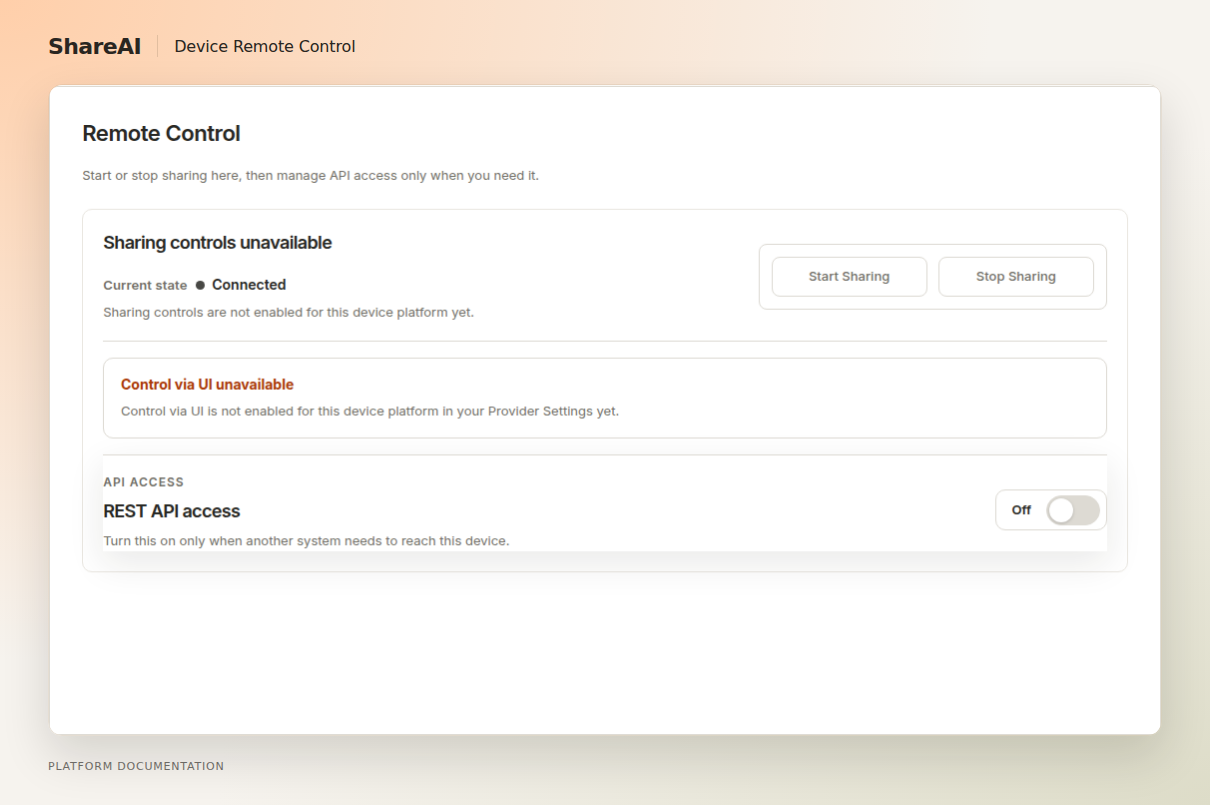
- Open the target device and its Remote Control tab. Enable Remote Control for that device.
- Create a named device access token and store its secret. Copy the provider UUID and device UUID shown for the same relationship.
- Authenticate with HTTP Basic: provider UUID as username, device access token as password.
Access boundary#
| Check | Requirement |
|---|---|
| Provider identity | The Basic username and path provider UUID must match the token’s provider. |
| Device identity | The path device UUID must match the token’s device relationship. |
| Provider access | Provider Remote Access must be enabled. |
| Device access | Remote Control must be enabled for this device. |
| Connection | The relationship must be connected or sharing. |
| Token state | The token must be active. |
Verify with a read#
GET
https://api.shareai.now/api/v1/console/provider/{provider_uuid}/device-management/{device_uuid}/remote/sessionsRead sessions for the authorized device.
- Base URL
https://api.shareai.now- Authentication
- HTTP Basic: provider UUID and device access token
cURL
curl --fail-with-body \
  "https://api.shareai.now/api/v1/console/provider/$PROVIDER_UUID/device-management/$DEVICE_UUID/remote/sessions?page=1&limit=20" \
  -u "$PROVIDER_UUID:$DEVICE_ACCESS_TOKEN"
When a request is denied#
Check the two enabled switches, the current connection, token status and both UUIDs. Do not use the device name, MAC address, owner email or a provider-level access token as a substitute. After reconnecting a device, recheck the relationship shown in Console.
Last updated September 15, 2026